May 1964
June 1964
 July-August 1964
| May 1964 |
Home
Newsletters
June 1964 | July-August 1964 |
 Calendar of EventsJune Units -- A Triple Treat!Summertime...Notes to You... From the President! (Nancy Dykes)Summer ScheduleVoters Service Plans OutlinedBarbara Ward Speech Available on TapeForms of City Government (Hazel Greer) Calendar of EventsJune Units -- A Triple Treat!Summertime...Notes to You... From the President! (Nancy Dykes)Summer ScheduleVoters Service Plans OutlinedBarbara Ward Speech Available on TapeForms of City Government (Hazel Greer) |
Forms of City GovernmentBackground information on forms of city government for June Unit Meetings
FOREWORD Good government, at any level, is not an accident: it is the result of an interested and informed public taking an active part in that government. The public of any city should at all times be aware of what is going on in that city: what the city charter permits and what it does not permit; how the local laws are formed and adopted and how they are administered. In 1733 Alexander Pope wrote this couplet:
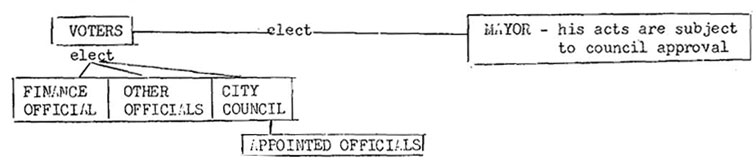
The public needs to maintain a constant vigilance to see that the laws are properly administered, to see that its rights are preserved and not abused. It should bring pressure to bear upon the nomination and election of the city council and to other matters pertinent to the welfare of the citizens. The citizens of Cincinnati, Ohio are interested to the extent that they have formed a committee known as the City Charter Committee of Cincinnati to see that the provisions of the city charter are faithfully carried out. Today, there are four forms of city or local government in use in the United States. The oldest form is the weak mayor-council system. It was joined In 1880 by the-strong-mayor-council. In 1901 Galveston, Texas suffered a severe tidal wave in which hundreds of people died. The mayor system was not effective in results following the disaster and the State Legislature of Texas granted the city a charter enabling it to form the first commission form of government. The fourth system is the Council-Manager Plan which was established in Staunton, Virginia in 1908 and received impetus when adopted by Dayton, Ohio in 1913. These forms are further explained by the following texts and charts. COMMISSION PLAN The uncomplicated pattern of the Commission form of city government is easy for the citizens in the municipality to understand. The voters elect a number of commissioners, usually three, five or seven, or more, depending on the size of the city to be governed. These commissioners then individually become the heads of various departments, together they form the city council, and execute both legislative and administrative powers. The mayor is elected from and by the council group and is usually named head of the Department of Public Safety. He represents the city on ceremonial occasions and presides over council meetings. He votes in the council but very rarely has the power of veto and does not exercise more authority than the other commissioners. The 1901 Galveston charter lacked a system of checks and balances but in 1907 in Des Moines, Iowa, in adopting the commission form some of these weaknesses were corrected. Des Moines added to the charter the initiative, referendum and recall. They also adopted the non-partisan election and the merit system. These reforms aided the spread of the commission form but in 1960 Galveston, and in 1949 Des Moines, switched to the Council-Manager plan. There are four strengths in the commission plan:
The one outstanding weakness of the system is the possibility for each commissioner to make his department the dominant one; both in use of public funds and in authority. Another weakness is the fusion of legislative and administrative powers.
COUNCIL-MANAGER PLAN The council-manager form of city government is an outgrowth and improvement over the commission form. Students of government give it unqualified backing. Very few cities have abandoned the council-manager plan after once trying it and today more and more cities are switching to it. This system has a weak mayor, a strong elected council and the council hires a manager who carries the responsibility of administering the city government. His term of office is indefinite and he is at all time accountable to the city council for carrying out its laws but is unhampered in the management thereof. This form is good because it separates legislation and administration; it places administration responsibility in the hands of a non-partisan expert. In case of error, it is easy to place responsibility. Due to the city council having no administrative duties and having to spend less time on the job this system attracts better qualified citizens to enter the race for council, as it permits them time for their own business affairs. This form also promotes efficiency.
STRONG MAYOR - COUNCIL SYSTEM The difference between the strong mayor-council system and the weak mayor-council system is in the powers delegated to the mayor and to the council respectively, and in the separation of legislative and administrative powers. The mayor and council are elected by the voters for a specified term, generally for two or four years, the longer term increasing in popularity. The mayor's power is contained in two principal categories: 1. Administration:
2. Legislative Power
WEAK MAYOR - COUNCIL SYSTEM Under this form of government, the oldest in use in the United States, the mayor must depend upon his ability to establish and maintain close relations with the city council to have effective government. In event of disputes between the mayor and council he is handicapped by his lack of power, and good and effective city government could be badly disrupted. The council, on the other hand, is in a strong position for it not only has legislative but also administrative powers. The council also prepares the city budget either with a committee from the council or with a board named for that purpose. The mayor may preside over or be a member of the committee or board but he has only equal authority with other members and does not exercise control. The council also approves Or disapproves appointments and removals of any officials made by the mayor. Several weaknesses are evident in this form:
This type of government is most widely used in smaller cities and it is the opinion of political students that it will be in use for many years to come, though it is losing ground to other forms. Two large cities still retain this form of city government, Los Angeles and Chicago. Both are successful.
Members of the Planning Commission Thomas N. Yamabe Hawaii Farm Bureau June 30, 1968 Frank T. Hustace Attorney June 30, 1967 retiring chairman Cyril Lemmon Architect June 30, 1964 Kinji Kamazawa Attorney June 30, 1965 George Centeio Real Estate June 30, 1966 chairman Alfred Yee Construction Engineer June 30, 1966 Stanley T. Himeno Airport Motors (VW) June 30, 1965 vice-chairman
Members of the City Council Masato Doi Attorney chairman Ernest N. Heen Real Estate vice-chairman Matsuo Takabuki Attorney Herman G. P. Lemke C.P.A. finance chairman Richard M. Kageyama Real Estate Clesson Y. Chikasuye Attorney William K... Among Attorney District 8 (A) Yoshiro Nakamura Attorney District 9 (B) Ben. F. Kaito Attorney District 10 (C)
Hazel Greer |
| May 1964 | Top Home Newsletters | July-August 1964 |